Restoration Local SEO
Local Citation Building for Fire and Water Mitigation Companies
How fire and water mitigation companies build NAP-perfect citation profiles that turn a Google Business Profile into a lead machine.
It's 3:00 AM. A homeowner wakes up to a burst pipe flooding their finished basement with Category 3 black water. What is the very first thing they do? They grab their smartphone in a panic and search Google for "water damage restoration near me."
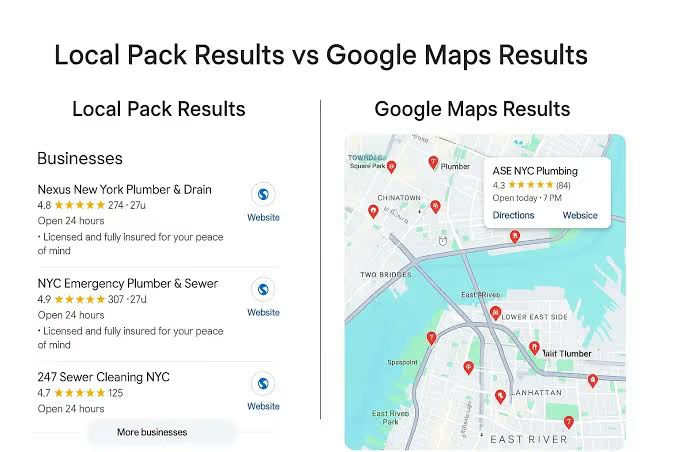
In the mitigation industry, search intent is hyper-urgent. The homeowner isn't comparison shopping; they are clicking the first reputable company they see in the Google Local Pack. If your mitigation business isn't dominating that map pack, you are losing high-ticket jobs to your competitors. Worse, you might be stuck paying astronomical Cost-Per-Click (CPC) rates on Google Ads just to keep your extractor trucks on the road.
To dominate local search without burning your entire marketing budget on ads, you need to build trust with Google's algorithm. For local SEO, trust is built through local citations.
If you want to understand how to leverage local citations restoration companies use to dominate their service areas, you need to master the art of the NAP. Here is your comprehensive guide to building a citation profile that turns your Google Business Profile into a lead-generation machine.
What Are Local Citations?
In the simplest terms, a local citation is any online mention of your mitigation company's core information. To be effective, this information must perfectly align with what we call the NAP:
Name
Your exact business name—no abbreviations, no DBA drift.
Address
Your exact physical location, including suite formatting.
Phone
Your local tracking number or primary business line.
Google's local search algorithm acts like a highly skeptical detective. Before it ranks your business at the top of the map pack for "fire damage repair," it wants undeniable proof that you are exactly who you say you are, and exactly where you say you are.
Citations act as third-party verifications. When Google scans the internet and sees your NAP perfectly replicated across dozens of high-authority websites, it validates your business entity. This consistency acts as a massive trust signal. Conversely, if your NAP is inconsistent—say, your Google profile says "Restoration Pros LLC" but Yelp says "Restoration Professionals"—Google's confidence drops, and so do your rankings.
Local Search Authority Simulator
Adjust citation volume and NAP consistency to see how both move your simulated authority score and Map Pack rank.
Search Visibility Scale ↑
Authority Score
5/100
Map Pack Rank
10+
Active directory listings (Yelp, BBB, IICRC, and similar).
Share of listings that perfectly match your Google Business Profile.
Key insight: Your digital footprint is too weak. To rank for competitive terms like "water damage restoration," you need both more listings and stricter NAP alignment.
For a deeper dive into the mechanics of the map pack, check out our Ultimate Guide to Local SEO for Restoration Companies.
The Core Foundation: Big Data Aggregators
You might be thinking you need to manually submit your business to thousands of obscure websites. Fortunately, the internet's data ecosystem doesn't work that way. Instead, a massive portion of online directories pull their information directly from a few primary sources known as Data Aggregators.
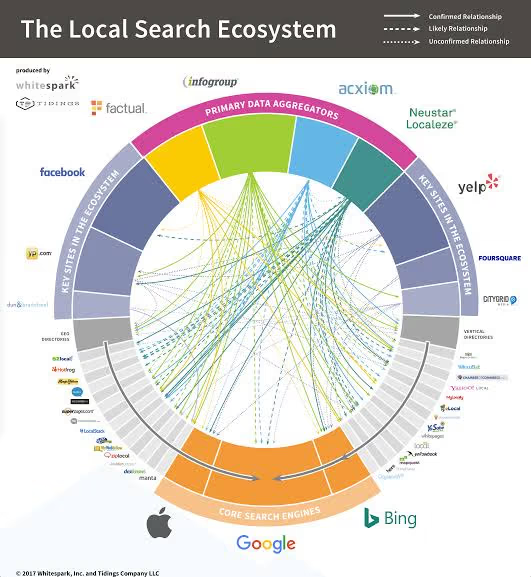
Data aggregators are massive databases that compile business information and syndicate it to hundreds of smaller search engines, mapping apps (like Apple Maps), voice assistants (like Siri and Alexa), and GPS systems.
The Big Three Aggregators
To establish a baseline of authority, you must ensure your NAP is perfectly accurate on the major data aggregators:
- 01
Data Axle(formerly Infogroup)
One of the largest suppliers of business data to navigation systems and in-car GPS. When a property manager is driving to a commercial fire loss and uses voice search to find you, Data Axle is often powering that result.
- 02
Foursquare
It's no longer just a check-in app; Foursquare operates one of the most robust location data platforms in the world. Their data feeds directly into Apple Maps, Uber, and Twitter.
- 03
Neustar Localeze
A massive aggregator that specializes in local search identity. Pushing your perfectly formatted NAP through Localeze ensures consistency across a vast network of tier-two directories.
Pro-Tip for Contractors
When you update these aggregators, ensure you use the exact business categories that match your services. Don't just select "Contractor." Ensure you are categorized under "Water Damage Restoration," "Fire Damage Restoration," or "Mold Remediation."
Niche and Industry Directories: Quality Over Quantity
While data aggregators provide a wide net, niche citations provide hyper-relevance. Google looks at the context of the websites linking to you. A citation from a highly respected restoration industry board carries significantly more weight than a citation from a generic web directory.
For the highest return on investment, local citations restoration companies build should heavily feature industry-specific authorities.
The IICRC Directory
If your technicians are sweating through Tyvek suits and pulling dry logs to ensure structural materials are properly mitigated, you know the importance of the Institute of Inspection, Cleaning and Restoration Certification (IICRC).
Being an IICRC Certified Firm isn't just a sales tool for adjusting firms; it's an incredibly powerful SEO citation. Ensure your company's profile on the IICRC Global Locator matches your Google Business Profile exactly. Google recognizes the IICRC domain as the ultimate authority in the restoration space.
Trust and Home Services Platforms
When dealing with a traumatized homeowner whose kitchen is covered in soot webbing after a grease fire, trust is everything. These directories signal to Google that you are a verified, consumer-trusted entity:
Better Business Bureau (BBB)
A BBB accreditation profile is one of the most powerful trust signals on the internet. It explicitly connects your business entity to verified consumer reviews and dispute resolutions.
Angi & HomeAdvisor
Even if you don't buy their lead generation services, you must claim and optimize your free profiles. These platforms hold immense domain authority in the home services sector.
Houzz
Frequently used by homeowners tackling major rebuilds after a disaster. A fully optimized Houzz profile with photos of your containment barriers and negative air pressure setups builds massive relevance.
The Local Chamber of Commerce
Do not overlook your immediate geographical area. A citation from your local Chamber of Commerce or city business association is incredibly potent. It proves to Google that you are an active, verified participant in the specific local economy you are trying to rank for.
These local links often end in .org or .gov, passing high-quality localized authority directly to your domain.
Unstructured Citations: The Secret Weapon for Restoration SEO
Most restoration owners stop at directory listings (structured citations). If you want to outrank the massive national franchises in your territory, you need to master unstructured citations.
| Feature | Structured Citations | Unstructured Citations |
|---|---|---|
| Format | Rigid directory fields (Yelp, YellowPages) | Organic mentions in paragraphs or articles |
| Primary Value | Establishes base entity trust & NAP consistency | Passes massive authority & localized relevance |
| How to Get Them | Manual submission or aggregator feeds | PR, community outreach, local news features |
| Competitor Difficulty | Easy (Anyone can build them) | Hard (Requires real-world networking & PR) |
An unstructured citation is a mention of your business NAP in the middle of a blog post, a news article, or a press release. It doesn't follow a strict directory format, but it signals immense real-world relevance to search engines.
Leveraging Major Storm Cleanup
Disaster restoration is a reactionary business. When a massive freeze bursts pipes across the county, or a localized flood hits a neighborhood, your company is on the front lines. This is a PR goldmine for unstructured citations.
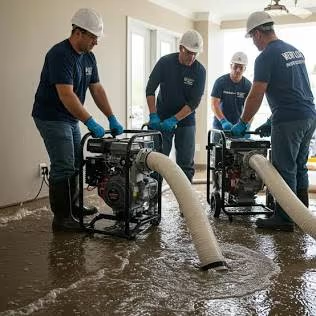
If your crews are pumping 50,000 gallons of water out of a flooded local high school, call the local news stations. Offer them an interview about the cleanup process, the dangers of mold growth, and what homeowners should do first. When the local newspaper or TV station publishes the story online, ensure they mention your company name, location, and phone number.
Community Relief and Sponsorships
Sponsoring local events is another powerful way to generate unstructured citations.
Sponsor a local Little League team or a 5K charity run.
Host a continuing education (CE) class for local insurance agents on reading thermal imaging cameras.
Donate industrial dehumidifiers or air scrubbers to a local charity event.
When these organizations thank their sponsors on their websites, they will often include your business name, address, and a link to your site. Because these are hyper-local organizations, Google views these mentions as highly authoritative geographic signals.
Best Practices for Citation Management
Building citations is only half the battle. Citation cleanup is just as critical.
If your mitigation company has been around for over a decade, there is a high probability your data is fragmented. You might have moved warehouses, changed your primary dispatch number, or updated your DBA.
The Danger of Duplicate Listings
If Google finds three different phone numbers associated with your business across the web, it gets confused. When the algorithm is confused, it simply demotes you and shows the searcher a competitor it can verify.
Citation cleanup ledger
Conduct an Audit
Manually search your business name, old phone numbers, and previous addresses on Google.
Consolidate and Correct
Claim those outdated profiles and manually update the NAP to match your current Google Business Profile flawlessly. Pay attention to formatting—if your Google profile says "Suite 100", don't let Yelp say "Ste 100".
Track Your Progress
Use spreadsheets to track login credentials and the status of every directory submission. Citation building takes time; directories can take weeks to approve an update.
Consistency is the ultimate currency in local SEO. The restoration companies that win the map pack aren't necessarily the ones with the largest fleet of trucks; they are the ones with the most flawless digital footprints.
Stop Chasing Leads. Let Your Mitigation Rankings Do the Work.
You didn't get into the disaster restoration business to become a full-time digital marketer. Your time is best spent managing project managers, negotiating with adjusters, and ensuring your crews are responding to emergency calls rapidly and safely.
Navigating data aggregators, hunting down duplicate listings, and structuring NAP profiles is tedious, highly technical work. But ignoring it means leaving hundreds of thousands of dollars in water mitigation and fire rebuild revenue on the table.
You need a partner who understands the difference between a category 1 and category 3 water loss, and more importantly, understands how to put your company in front of the homeowner the second that loss occurs.
Ready to stop paying for shared leads and start dominating your local market?
Contact our Restoration SEO Agency today. Let our experts run a comprehensive audit of your local citations, clean up your digital footprint, and build a localized SEO strategy that keeps your phones ringing with high-ticket emergency jobs. Schedule your free strategy consultation now.